
Showing posts with label culture. Show all posts

Thursday, October 18, 2012


Yikes, almost been a month since I've posted!  I hadn't realized so much time had passed...we've had a busy month with several different activities, including a women's retreat, a quick trip to Mexico City to renew Jkaile's U.S. passport and Jojo's birthday!  I think the highlight of the last few weeks, however, was the trip we made to the towns of Ixtepec and Cuetzalan with the Sexton family.  The Sextons are appointees with Pioneers and were on their vision trip to scout out the different PI teams in Mexico to see where God might be leading them to work in the future.

Town of Ixtepec

And of course, they couldn't really get to know what our ministry is about unless they made a visit to some Totonacan communities in the mountains, which we were happy to show them! We chose to take them to visit Miguel and Magdalena and family in Ixtepec, where we spent two nights before spending the day at the Coffee Festival in the town of Cuetzalan.

We had so many experiences in those three short days, it would be hard to describe it all here in one post, but I will try to highlight the important parts...or at least the parts that I thought were most interesting!

Miguel had visited Ixtepec before, but this was my first time there.  I really hit it off with Magdalena and we ended up talking until late that first night we were there, as we shared our hearts with each other.  The conversation continued the next day as she showed us around town (the guys had all gone to Mr. Miguel's garden). I was honored that she was so open with me about her life experiences and I shared back with her about some of mine.

Magdalena preparing corn tortillas

Miguel and Magdalena with a Proclaimer
(audio Scripture device)...it has the New Testament
in their Totonacan dialect

The next day, we were invited to eat at another family's house and they served us each a large piece of fried pork with black beans and freshly made corn tortillas...which was humbling because their house is very small, has a dirt floor, and the walls are made out of 'carrizo', which are cornstalks woven together.


The next day, this family also bought us a bunch of cookies for our trip home! We had a great time at their house, Miguel shared some thoughts on Bible storytelling with the family, the kids chased chickens and saw their bunnies and Micah found a meteorite!

After lunch, we visited another family who lived a ways out of town where Jojo had an interesting experience in their outhouse...he had to go while we were there, but the outhouse was even more primitive than usual and just had a hole with nothing to sit on.  Once he figured out how to use it, we realized we had forgotten to bring the toilet paper with us from the van.  After some thought, the kids decided to give him some banana leaves!  Then Jkaile thought it would be fun to wipe with banana leaves as well, but to his great disappointment, he couldn't produce anything that needed wiping! Boys...

I didn't get any pictures during that visit because I was busy practicing the Bible story that I was to present in the Miguel and Magdalena's church that night. The people consider us to be something like pastors, even though we've tried to avoid having that image, so when they heard we were coming, they asked if we would speak at their church (they are without a full-time pastor right now). We agreed, but decided to present the teaching in a Bible story format with Miguel presenting part of it and me the other.

My part was to share the story of the birth and life of John the Baptist and I was having trouble remembering all of it, particularly the parts that contained prophecy about Jesus. I also struggle a bit to remember the stories when I present them in Spanish, which obviously is my second language.  So I was practicing the story when Magdalena informed me that they would be translating it to Totonacan during the service...I didn't know that, so I asked her to help me practice it with a 'live' translation. She did that for me and then she told me that since she liked the story so much, she wanted to translate for me in church that night, even though she wasn't the 'designated' translator!  I was pleased because I had enjoyed working with her and I think we make a great team.

It seemed like the people enjoyed the story that we presented.  We're just beginning to learn more about oral communication principles and how to put them in practice. These concepts are definitely new for the Totonacans.  Traditionally, they are an oral culture, but oral communication principles have not been used much in church settings. We're in the process of exploring how oral communication principles could be used in evangelization and discipleship in the Totonacan context and we're excited about the possibilities because so far, they are responding positively. But that is a whole other topic for another day...

It was hard to say goodbye to Miguel and Magdalena the next day, but we hope to go back to visit soon!  The town of Cuetzalan is not too far from Ixtepec, but the roads were quite twisty and sure enough, some of us were getting a bit carsick! At one point, Jojo threw up quite violently and we had to pull over to get him cleaned up (I even had to wash his hair!). Fortunately, we quickly found a place where someone had built a small tank to hold the water being piped down the hill.  It was there, basically out in the boonies, that we met a man who spoke English because he had lived in New York for many years!  You just never know who you will run into!

We finally got to Cuetzalan, where we planned to enjoy the last day of the Coffee Festival (and yes, I bought some coffee, about 3 pounds of whole beans).  The sights were quite enjoyable as there were many traditional Totonacan dancers there from many different towns participating in the traditional ceremonies and rituals.

 Totonacan 'voladores' (flyers) performing
in front of the Catholic church

Colorful dancers

Religious procession taking saints 
and other images into the church

Lots of Totonacans in traditional dress

Cool shops
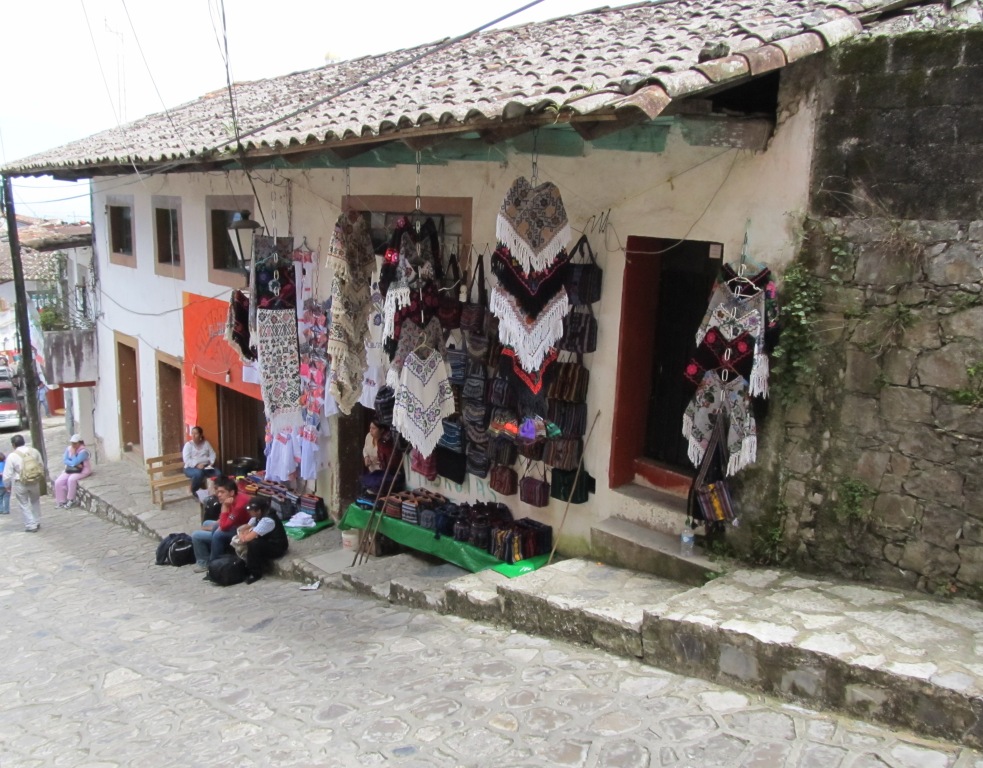
We liked Cuetzalan a lot and we felt like we didn't get enough time to really explore as we'd have liked...there are some caves, waterfalls and ruins in the area that we'd like to go see sometime.  Every time we go to the mountains, it seems like it's getting harder and harder to come home...I think we'd like to make one of these mountain communities our home!

The town of Nanacatlán

On the way home, we caught a glimpse of Orizaba at sunset, truly a breathtaking sight!  Orizaba is the highest peak in all of Mexico and is often covered in clouds, so we were thrilled to catch these pictures.


*Other links from this trip...Gracia writes about the animals we saw and Jkaile is impressed by the pig.

Thursday, March 15, 2012

Cultural Perspectives on Modesty

It's not often that culture shock really hits me any more. Not that I am above culture shock, just that I continue to adapt to the Latin culture more and more. While I may have moments of confusion or discomfort, I generally feel fairly comfortable in most situations these days, or at least I can sort of figure out what's going on.

So it really caught me by surprise the other day when something happened that left me standing speechless, mouth hung open.

The kids and I went to a balneario (swimming pool) last Sunday with our neighbors and some of their friends.  I went to the locker room to change into my swimsuit.  I didn't see any changing rooms, so just changed in one of the toilet stalls.  When I came out, that's when I saw it. Women walking around, well, completely naked. No pena (shame). No attempts to even try to cover any part of themselves as they walked back and forth to the showers and toilet stalls.  I think I froze.  I hope I didn't stare!  Am I just a prude?

It's not like I'm not used to nudity...after all, the tribal group my parents worked with in Colombia didn't really use much clothing and it never really bothered or affected me because that's just the way they were and I accepted it.

But I guess this is one aspect of the Mexican culture that I had not yet been exposed to (no pun intended!), because it really caught me unaware.  I returned to where my friends were sitting and I debated whether or not to mention it, but then I realized it was a great opportunity to get some further insight into the culture here.

They laughed when I told them, and it did lead into an interesting conversation about cultural perspectives on modesty, etc.  Apparently, complete nudity is quite common here in women's locker rooms and steam baths and is nothing to be embarrassed about.

They were quite interested in the fact that the nudity would surprise me since they had the idea that everyone from the U.S. is quite liberal in all things.  I shared with them that not all Americans are frat-party, girls-gone-wild, Spring-Break-at-Panama-City-Beach sort of people like they might see on t.v.  That some of us are from staid, Bible-beltish Midwest region and we don't necessarily care to bare ourselves in front of other people at the drop of a hat.

Most locker rooms in the U.S. that I've seen have individual changing rooms and I would say that most people, well, women anyway (I don't think that I am qualified to comment on men's locker room habits), would avail themselves of the changing rooms instead of changing out in the open.  And most would probably use a towel or something to cover at least some part of their bodies in the locker room (of course, I could be out of touch with reality since I'm not that up on popular culture back in the U.S. these days).

We talked about other aspects of modesty, other differences.  In Mexico, many women feel very comfortable showing more cleavage than is normal in the U.S. (well, at least in many places in the states and among more conservative people).  It is more appropriate for women in the U.S. to cover up more of the chest area than here in Mexico.

On the other hand, most Mexican women cover up their legs much more than in the U.S.  My friends told me that until recently, most women still wore skirts in this part of the country.  While pants and blue jeans are now very common here, skirts are still worn by many older women, especially in the more rural areas.

Although it was interesting for me to notice that at the pool, there was a wide range of bathing suits, from quite revealing to rather modest.  I gather that in that particular setting, it is not inappropriate to wear even a very revealing suit. I did notice, however, that while not actually in the pool, most of the women preferred to wear some sort of cover over their suit. And there were quite a few older women who didn't even swim or get close to the pool, they were there just to accompany the family.

In comparison to the U.S., shorts are rarely worn in public here in Mexico except for specific events, such as for exercise and sports.  According to my friends, this is because the sight of skin on legs, especially above the knee, is more of a turn-on for Latin guys.  Pants and jeans are often very tight, but as long as skin is not showing it is considered modest.  My neighbor told me that in many cases of violence against a woman, she might be blamed for the violence by dressing provocatively, showing too much of her legs.

This is an interesting contrast because in the U.S. shorts and short skirts are very common and not necessarily considered immodest or inappropriate for public attire.  

So anyway, I've been thinking more about cultural differences and how much I have yet to learn about the Mexican culture.  There will most likely be some more surprises for me around the corner...

So when it came time to change back into our regular clothes, Gracia and I headed back to the locker room.  We thought about changing in the main room just like everyone else, but when push came to shove, we just couldn't do it...so it was back to the toilet stalls for us...maybe next time.

Wednesday, November 2, 2011

The Days of the Dead

I've always been a little confused about what exactly is the Día de los Muertos (Day of the Dead) here in Mexico and I assumed that it had something to do with the American celebration of Halloween.  I have learned a little bit more about this celebration, however, and have found out that the origin of Halloween is really All Hallows' Eve.  All Hallows' Eve is the night before All Saints' Day, which falls on November 1st.  And November 2nd is All Souls' Day.  

So while Halloween kind of has something to do with the Día de los Muertos, the American celebration of Halloween that I am familiar with and the Mexican celebration of the Día de los Muertos is a lot different (Mexicans do still participate in Halloween-like activities, such as dressing up in costumes and trick-or-treating...yesterday I saw a little boy in a fringed cowboy costume made completely out of newspaper!).     Obviously, there is an entire history behind these celebrations and the customs will vary from place to place, but this year we have been doing our own culture study on this celebration and are learning from our neighbors and other sources here about their beliefs regarding the Día de los Muertos.

What we have learned is that these are days when families remember and honor their dead loved ones and it is traditionally a time to visit and decorate their graves.  While this reminds me of Memorial Day in the U.S., there is a lot more involved with the Día de los Muertos than merely remembering loved ones.

A Triqui woman pouring Coca-Cola on the grave
of a loved one, Baja California.

It is believed that once a year, the ánimas (souls) of dead loved ones come back from the dead to visit their relatives.  The souls of children and unmarried young people are believed to come on All Saints' Day and the souls of adults or married people are believed to come on All Souls' Day.  Ofrendas (offerings) are made on sometimes elaborate altars in homes or cemeteries to honor and receive the souls.  Candles are burned as it is believed that their light will guide the souls to the altars.  Brightly colored flowers with strong smells, such as marigolds are commonly used to also guide the souls to the offerings.  Incense, such as copal (tree resin incense) is also burned by some.

A trail of flower petals leading into a house.

A trail of flower petals leading to an ofrenda at a school.

Many different foods or other things can be included in the offering, such as pan de muerto (literally, the bread of the dead), whiskey and other drinks, tamales, cigarettes, mole (a traditional chile and chocolate dish), sugar skulls, toys and candy (for the younger souls), sugarcane, fruit and other items that may have been favorites of the dead loved ones.

Pan de muerto, topped with bone-like decorations.

While the Día de los Muertos isn't necessarily a state holiday, we have observed that the 1st and 2nd day of November are días festivos (festive days) and that schools are closed on November 2nd.  Many of our friends who are followers of Christ do not send their children to school around this time of year in order to avoid having their children participate in the celebrations they view as demonic and pagan.

The sign on the gate of the preschool next door to our house says: 
"Homework for everyone: bring a written skeleton for 
Monday and fruit for the offering.  Thank you."

An ofrenda at a town government office.

Another example of an ofrenda set up at a police station.

There is a sign on this ofrenda that says,
"Please don't take anything off of the offering."

An ofrenda set up inside a Catholic church.

Traditionally, on November 3rd families have parties where the offerings are eaten in honor of their dead loved ones.  It is believed that the essence or aromas and the colors of the food and flowers are 'eaten' or used by the dead and some would say that the food that is left has no nutritional value.  

I'm sure that there is a lot more to learn about the Día de los Muertos, but this has been an interesting glimpse into these traditions here in Puebla.  

Saturday, October 2, 2010

Acceptance: Communicating Respect for Others-Part II

To read Acceptance, Part I, click here...

Trouble in the Church

Differences in the the various churches Rome and Corinth had the effect of making sides...fellow believers were either 'in' or they were 'out' (I Cor. 1:11-13).  Paul labelled these differences as 'disputable matters', or gray areas that should not break fellowship (Romans 14:1)...we should not look down on anyone who believes a bit differently about these 'disputable matters'...and Paul goes on to point out that an accepting Christian should value others so highly that they would rather sacrifice a personal preference or even a right than risk losing the relationship or cause another to have a problem (I Cor. 8:13).

To Accept is to Bless

In the Bible, particularly the Old Testament, to bless someone was a way to communicate acceptance.  In fact, the word 'blessing' means 'to highly value someone or something'.  Blessing can be viewed in relationships in the following way...God blesses people, people bless each other, and people bless God.  In a multicultural world, the church is called to 'bless the nations' by valuing persons and cultures in their uniqueness.  God calls us to demonstrate to the world the high value and worth God has placed on each person...and not only each person, but also each family, ethnicity, tribe, tongue and nation. 

Dignity: The Sacred Endowment

God created humans in his image...people bear God's image.  God has shared something unique and of himself with every single person on the face of this earth...God desires that we see his face when we look into the face of another...no one is insignificant...no one is worthless...life has meaning and each of us has meaning and importance because God's own imprint is upon our humanity.  Therefore, it is our responsibility to see others as God sees them...treat them as he would treat them...name them as he names them...either we treat them with the respect and dignity that God has given them or we profane God's image in that other person by treating them with less value...

Factors Limiting our Acceptance of Others

1) Language - in cross-cultural situations, language limits our ability to verbally communicate acceptance to others...and to make no effort to learn or use another's language is, in itself, a form of rejection.  People don't separate themselves from the language they use because it is how we define ourselves and how we make meaning out of life...to not know my language equates not knowing me....for short-term missionaries, it is important to make an effort to learn some greetings and a farewell in order to communicate that they value others... 

2)  Impatience - impatience limits acceptance of others...we often like to see things happen more quickly than they do...and in many parts of the world, waiting is a nonissue and an integral part of life...meetings don't start 'on time', roads are bad, lines are long, traffic backed up...for a Westerner, all of the waiting can be very frustrating because it is not what we are accustomed to...it is important to find ways to deal with life's frustrations or these frustrations will affect our ability to value and celebrate people...the author points out that if impatience is a problem for you in your home culture, then you will definitely have your patience tested in a cross-cultural situation...he goes on to suggest a few ways to cope...without having strategies to cope with the frustrations, he points out that negative emotions will build and people will sense rejection from you, which can have the effect of damaging your ministry...

          a) become a people watcher - it can be both intriguing and informational
                 -after observing people, try to name the values you see them living out
          b) carry reading material
          c) take Scripture memory cards with you
          d)  start a conversation with someone who does not appear to be too busy
          e) do light aerobics or stretching exercises if possible

3) Ethnocentrism - defined as "the tendency of every person to believe that their own cultural values and traditions are superior to those of other cultures".  Ethnocentrism can be an unconscious hindrance in communicating acceptance...and the more the other culture is different than mine, the more I am inclined to make unfavorable judgments.  Ethnocentrism exists in every culture, but the author points out that perhaps Americans reveal their ethnocentrism more quickly and assertively because they are more direct and forthright with their thoughts and opinions...perhaps for this reason many people from other cultures perceive Americans to be arrogant and controlling...Americans are usually quick to identify a problem, offer a solution and then get on with fixing it...what is seen as virtues in the American culture can be perceived as aggressive and paternalistic in other, making them feel inferior, weak, defective or disrespected...as a result making the good we intend not be seen as 'good' and the blessing we try to give from acceptance not felt. 

One of the typical American responses is to ask "Why didn't they tell us? They should say something if we aren't doing it right."  Many times, people from other cultures are 'saying something' loudly and clearly for their culture...we Americans just can't hear them because of our cultural tradition of speaking more openly and directly.  People from other cultures may use nonverbal communication or tell stories to communicate their attitude or opinion on a matter...it is important to learn how people from the local culture communicate so that you can gain insight into their culture and grow in sensitivity and understanding. 

4) Category Width - we all have categories by which we organize the world, make decisions and avoid confusion...these categories help us distinguish between things, such as trucks and chipmunks, telephones and golf balls, people and light bulbs...we name everything around us and those names become the categories by which we think...a person with wider categories can accept a broader range of items in a category and a person with narrower categories would rather create a new category than expand an existing one. 

In a cross-cultural situation, the person with wider categories might put more things in the "cultural differences" category wheras a person with more narrow categories might not be inclined to stretch the existing categories and instead put many of the differences into the 'wrong' category...the person with narrow categories has tighter definitions of 'right', 'wrong' and 'different'...this can cause a lot of conflict between missionaries themselves and between missionaries and nationals...

Both types of people have wonderful strengths...however, the author points out that people with more narrow categories has some tendencies that could hinder relationships because "they tend to be more ethnocentric, more reactionary and seek less information before forming judgments".  People with wider categories tend to look for more information before making judgments and are more likely to put cultural differences into a 'neutral' category before placing it into the 'wrong' category...it is important, then, for some of us to use more caution before making a judgment just so that we can avoid acting or thinking in ways that would be unfair to local people.

5) Dogmatism - refers to "the degree of rigidity with which we hold our beliefs, our cultural traditions, our personal perferences"...the person that holds very firmly to their own beliefs and traditions tends to see differences as things that are wrong and inferior and that need to be corrected...such a person lacks "openness in communication because of rigid boundaries of belief or practice...in a culture."  Some things require dogmatism, it's true, especially when we have confidence in the Bible...but we should not be dogmatic about all things...it is important to recognize that there is a subtle tendency in all of us to believe that all of my cultural traditions and beliefs are best and that can cause us to slide into judging others from the perspective of our own culture and our own personal and theological views...

Acceptance over Evaluation

The author points out that social research indicates that the most frequent response that Americans make to a situation is to evaluate what they just saw or heard as 'right' or 'wrong', 'good' or 'bad'...usually the standard for such a judgment is how similar or dissimilar it is to me and my beliefs...we often use ourselves as the norm by which to measure others...if they measure up, we can accept them, but if not, we try to change them (one form of rejection) or distance ourselves from them (another form of rejection). 

It's a good idea to monitor our thoughts and words to see how often we use evaluative language with those around us...the author throws out a few examples:  "I like or dislike; I approve or disapprove; I am drawn toward or shun; this is right or wrong; it's acceptable or unacceptable, cool or uncool, nice or mean, attractive or unfavorable."  Rather than defaulting to evaluative thoughts and words, it is good to try to affirm, describe, inquire or express empathy instead...

The author uses a quote by anthropologists Sherwood Lingenfelter and Marvin Mayers speaking of the cross-cultural context: "One of the biggest problems...is that we often insist that others think and judge in the same way we do.  We do not accept one another in love, but rather we try to remake those around us into our own image." 

That inclination to remake others in our own image is called 'cultural cloning'...people end up looking more like us than like Christ...but the acceptance of people in their own cultural traditions helps us move from cultural cloning to discipling into the image of Christ...true servanthood means helping people look more like Christ, not more like us...

Monday, September 13, 2010

Acceptance: Communicating Respect for Others-Part I

Acceptance: The Second Step of the Pilgrimage*
Links for previous posts in this series here and here...

Acceptance and rejection are among the most powerful behaviors known to man...how many of your devastating life experiences come from feeling rejected--no longer accepted?  And how many of your cherished experiences come as a result of feeling completely accepted--one of the group, trusted, secure, respected, wanted, valued, desired.  Life feels good when we feel accepted. 

Acceptance is defined as the ability to communicate value, worth and esteem to another person. 

Four Major Points regarding Acceptance:

1)  Acceptance begins with God. 

Romans 15:7..."Accept one another, then, just as Christ accepted you, in order to bring praise to God." 
  • Jesus took the initiative in accepting me; he took the first big step toward establishing the relationship with me
  • He accepted me without any conditions, not based on my performance; in spite of my sin and weaknesses, he accepted me just as I was
  • His acceptance of me is forever, no termination point
  • Because he accepts me, I am secure, no fear of exclusion or dismissal
  • He sees me as a person, without ethnicity, gender, nationality or social status labels
  • He valued me enough to give up his life; accepting me cost him dearly
  • "While we were still sinners, Christ died for us" (Romans 5:8) expressses God's profound acceptance of us, the degree to which he valued us, and his desire for a relationship with us
2)  The second major point is that we are to "accept one another" with the standard being "as Christ accepted you."  With this standard in mind, accepting one another will look like this...
  • We are to take the initiative in showing acceptance toward others, making them feel valued and respected
  • We unconditiaonlly accept others without considering their external features, lifestyle, decisions, habits and so forth (acceptance does not equal approval)
  • We do not have the option of rejecting any person, though we may, in a culturally appropriate way, address behaviors that the Bible clearly declares as sinful
  • We are to avoid dehumanizing behaviors such as threats, intimidations, power-plays and other ungodly forms of manipulation
  • We accept people, period.  Like Jesus, we must reject labels such as race, generation and gender as defective guides for how to treat another human being
  • We expect that accepting others in these ways may cost us dearly
3)  The third major point "connects acceptance of others with the glory of God.  Something amazing happens when the people of God become accepting people.  It reveals the glory of God.  Here is the lesson for all who work cross-culturally and belong to Christ.  Accepting one another may be among the most powerful acts of love we can offer to each other because it promotes oneness.  Oneness in Christ is so wonderful that the natural expression is to sing the praises of God.  The world notices the healing love and wholeness of the body and sees a great and mighty God.  They see his glory."

4)  The fourth major point  is that accepting each other promotes the mission of God...when we accept one another in spite of our differences, it promotes unity in the body of Christ.  This unity reveals the glory of God and the power of his love...if Satan can create dissension among Christians, then they will not be able to accomplish much of significance...therefore, accepting each other becomes "absolutely central to the mission God has given us!" 

*Notes for this post taken from the book Cross-Cultural Servanthood: Serving the World in Christlike Humility by Duane Elmer.

Friday, July 16, 2010

My Friend Sol

I first met my friend Sol on the sidewalk by the parking lot of the married housing at the University of Arkansas.  Miguel and I were moving to Arkansas to be closer to his job and I was transferring to the U of A.  My Mom, younger sister and I were struggling to carry our king-size mattress into our apartment.  Sol stopped to offer her help in broken English.  Recognizing Sol for a Spanish speaker, my Mom stopped to talk to her.

The expression on Sol's face changed from one of cautiousness to joyful radiance that we spoke her language.  I would like to say that I stopped what I was doing to take the time to properly greet and show openness to Sol, but I let my Mom do that.  Of course I should have known better, but after briefly acknowledging her existence, I, the task-oriented Westerner, continued working on the job at hand...unloading the truck.  After Mom and Sol were done talking, we all worked to wrestle the mattress and box springs into our tiny on-campus apartment and thanked Sol for her help.

Turns out Sol and her family occupied the apartment right next to us...a divine appointment.  After a few weeks, we began slowly getting to know our new neighbors...Ciro, Sol's husband, and Sol were from Mexico and seemed open to friendship.  Miguel and I agreed to pursue a friendship with them with the idea of eventually offering to have a Bible study with them.  So we intentionally befriended them even though it was hard...we didn't know the Mexican culture very well and we sensed strong tensions in the home, at times even oppression.

After about a year of working to gain their confidence, we tentatively offered the Bible study and they accepted.  We found out later that they had already rejected the Catholic faith because it had not served their needs and they were openly searching for truth.  I began a Bible study with Sol and Miguel started with Ciro, both of us using the chronological method, but separately.  Looking back now, I realize we had little idea of what we were doing, but we blundered through by the grace of God.  Little by little Sol opened up more and more to me as confidence and trust grew in the relationship. Eventually, we found out that they did have serious family and marriage issues and that demonic oppression was a part of their lives.  I know that God works miracles because both Ciro and Sol are now both fellow believers and our brother and sister in Christ.

One day, however, once Sol and I were fast friends and trust levels were high, she reminded me of that first day we met out there on the sidewalk.  She told me that she knew that my Mom liked her right away, but she felt rejected by me because I did not take the time to talk to her and get to know her right there when we met.

She told me that the day she met me, she honestly thought I didn't like her because her skin was dark.

I cried.

Wednesday, July 14, 2010

Openness: Welcoming Others Into Your Presence*

**Openness: The First Step of the Pilgrimage

"This man welcomes sinners and eats with them." Luke 15:2

Openness is defined as the ability to welcome people into your presence and make them feel safe.

Three important observations the author makes regarding openness:

  1. It is important to note that the author emphasizes that being open toward others is an ability...even if we aren't particularly good at it, we can practice and get better.  
  2. Openness is directed toward people--others like ourselves and those who are unlike us.  
  3. Openness must be expressed in culturally appropriate ways so that others feel both welcomed and secure in our presence.  This will, of course, mean different things in different places.
  4. Practicing openness in a different culture will require that we change.  A good quote about using the term embrace when speaking of welcoming others into our presence..."The will to give ourselves to others and 'welcome' them, to readjust our identities to make space for them, is prior to any judgment about others, except that of identifying with them in their humanity."
On the cross, Jesus' arms were wide open and he signaled his openness to receive those who would come to him in repentance...it was not only openness to repentant sinners, however, but also to those wishing to draw near for comfort, peace, refuge, hope and grace.  Therefore, the author points out that openness is grounded in the very nature of God.

Openness is also illustrated in the biblical concept of hospitality, mentioned various times in Scripture.  Hospitality describes an attitude of extending grace to people, including the stranger and those who are different.  It does include inviting people into your home, but the concept is expanded in Scripture to include extending love to those we don't know and who may be quite different from us...being gracious to all people, welcoming them into your presence and making them feel valued.  

The word hospitality is rooted in the word hospital, which Greek roots mean "loving the stranger" and later "house for strangers."  Eventually, the word hospital came be be known as a place of healing...the word hospitality meant connecting with strangers in such a way that healing took place.  Welcoming people just as they are and inviting them to join us just as we are therefore becomes a sacred event reflecting what Jesus did for us--providing us with a healing relationship.

A Western tendency is to quickly categorize people and things.  Westerners like to know where things or people fit because then it is easier to manage them or the relationship.  One way Westerners do this is by using the categories "like me" or "unlike me."  The "like me" category tends to become the "approved" category that Westerners approve and promote.  However, things that fall into the "unlike me" category tend to be viewed with suspicion, distance, critiquing and trying to change it (or you) to look more like me.

Skills for Openness - practicing these skills in your home culture will make them more natural so that when you do encounter or enter in to another culture, you won't need to develop them as much as just find appropriate ways to express them. 

1.  Suspending judgment

Making a judgment about something or someone is the same as coming to a conclusion.  If the conclusion is wrong, however, we have acted unjustly toward the person.  And once we have formed a conclusion, our mind may become closed to new information that might change our conclusion.  Often, once our conclusion is formed, the tendency is to see only the evidence that confirms that conclusion.     

When we are confronted with a new culture and a multitude of differences, we are all prone to judge from our own cultural perspective and therefore likely to see negatively what God sees as merely a difference.  If it is truly only a difference and not wrong, then we should try to stay open and be accepting. 

Developing our ability to suspend judgment helps us to follow God's caution about judging only with extreme caution so as to avoid misjudging another human being and therefore touch Jesus with the same disregard.  Suspending judgment is the first skill we need in order to maintain openness...it keeps us from making premature negative judgments and keeps us open to new information that may help us judge accurately.

Steps to avoiding premature negative judgments:
  1. Recognize that you might be making a negative judgment...ask yourself the question, Am I jumping to a negative conclusion?
  2. Stop when you recognize a negative thought or make a negative comment or judgment.  Ask whether you have enough information to be negative about that person...ask whether you should suspend judgment, get more information and get more cultural understanding before making a conclusion. 
  3. Ask yourself whether the observed behavior violates some clear mandate of Scripture or whether it is merely a cultural difference?
  4. If the behavior does, in fact, appear to violate a clear biblical mandate, ask yourself how you could respond so that you still continue to show openness while addressing the situation.  Great wisdom is needed for such a response and should not be done quickly...the correct response will probably not look the same as it would in your own culture.
  5. Unless you a person who has spent many years in the foreign culture, it would be wise to ask for counsel from a mature local pastor or an experienced missionary rather than adressing the issue yourself.
  6. If it turns out that the issue is merely a cultural difference, then remain open and celebrate it as part of God's diversity...try to understand how this difference is part of the larger picture of the culture.
Anytime we evaluate another culture from our own cultural perspective, the other culture will most likely look worse because we naturally favor our own cultural perspective and believe it to be superior.  This kind of ethnocentrism can cause us to assign negative attributes to the things we observe.  James 1:19 admonishes us to be quick to listen and slow to speak...good advice for the cross-cultural context!

2.  Tolerance for ambiguity 

A tolerance for ambiguity means living in uncertainty for periods of time...uncertainty has the tendency to drain our emotional strength and lower our physical capacity.  Most Westerners prefer not to live in uncertainty and manage their lives using PDAs, daily planner and agendas, leaving little room for the unexpected or ambiguous.  Westerners work very hard to avoid uncertainty and to live an ordered, predictable life because the unknown and unexpected are viewed as unwelcome intrusions in the schedule.  Other cultures, however, are very different and may not be as concerned about avoiding the unexpected or ambiguous as Westerners. 

When a person enters into a new culture, therefore, ambiguities abound.  The temptation is to hide or escape, but we can get better at handling the discomforts by keeping an open mind, processing our observations and asking questions.  The ability to tolerate ambiguity will allow us to hang in there when we would prefer to criticize or run away.

3.  Thinking gray

"The essence of thinking gray is this: don't form an opinion about an important matter until you've heard all the relevant facts."  Steven Sample

4.  Positive attribution

Negative attribution thinks the worst about others when there is uncertainty, but positive attribution assumes the best (while not being naive).  Try to develop the ability to intentionally think the best about people and then, if necessary, notice some of the less pleasant things on the side.  Positive attribution is a powerful tool in keeping us open towards others, which allows for a stronger relationship to develop.

A Restriction on Openness

The author throws in a caution at the end of this chapter to emphasize that openness to other cultures does not in any way equal religious relativism.  The challenge in cross-cultural relationships and ministry is to communicate grace to all peoples and yet affirm that the Bible is the authoritative truth of God. 

Our job is to remain open to the cultural diversity and to seek to adjust to the local culture without violating clear biblical principles or a clear mandate of Scripture.  Openness to these cultural differences will naturally lead us into the next step in being a cross-cultural servant, which is Acceptance. 

*Sorry, but you will be hearing a lot from me about this topic of cross-cultural ministry...it's what I'm really passionate about right now as God works on my heart in this very area.  I hope it will bless you as much as it's blessed me!

**Notes for this post taken from the book Cross-Cultural Servanthood: Serving the World in Christlike Humility by Duane Elmer.  I highly recommend you get this book, by the way...it might change your life!

Friday, July 2, 2010

Servanthood: The Process

Becoming a servant can be compared to a journey or a pilgrimage...while the steps described in Duane Elmer's book Cross-Cultural Servanthood: Serving the World in Christlike Humility aren't very complicated, the author points out that they do take a considerable amount of effort and discipline to carry out simply because we're used to servant practices in our own culture.  Merely calling ourselves a 'servant', doesn't mean that we will necessarily be perceived as such by others, especially if they are from another culture. 

I love how this book points out that I need to intentionally, every day, ask what I have learned about how a servant looks and acts in the local culture where I live.  I think that all too often, I tend to slip back into my usual, comfortable daily routine that is based in my own cultural experience and forget to stay on top of what it means to serve in another culture.  And the danger there is that I might become guilty once again of acting  like a "monkey". 

The cross-cultural servant model presented in this book is very practical and can actually be used as a guide in any relationship, whether it is cross-cultural or not. 

So here you go, a model of the steps towards becoming a cross-cultural servant.  The author lists the steps backwards since he feels they make more sense that way when first presented:

  1. Serving.  You can't serve someone you do not understand; at best you will serve like the monkey.
  2. Understanding.  You can't understand others until you have learned about, from and with them.
  3. Learning.  You can't learn important information from someone until there is trust in the relationship.
  4. Trust.  To build trust others must know that you accept and value them as people.
  5. Acceptance.  Before you can communicate acceptance, people must experience your openness - your ability to welcome them into your presence.
  6. Openness.  Openness with people different from yourself requires that you are willing to step out of your comfort zone to initiate and sustain relationships in a world of cultural differences. 

Monday, June 28, 2010

The Monkey "Serves" the Fish

**A typhoon had temporarily stranded a monkey on an island.  In a secure, protected place on the shore, while waiting for the raging waters to recede, he spotted a fish swimming against the current.  It seemed obvious to the monkey that the fish was struggling and in need of assistance.  Being of kind heart, the monkey resolved to help the fish.

A tree precariously dangled over the very spot where the fish seemed to be struggling.  At considerable risk to himself, the monkey moved far out on a limb, reached down and snatched the fish from the threatening waters.  Immediately scurrying back to the safety of his shelter, he carefully laid the fish on dry ground. 

For a few moments the fish showed excitement, but soon settled into a peaceful rest.  Joy and satisfaction swelled inside the monkey.  He had successfully helped another creature.

Even though the monkey may have had good intentions, it was arrogant for the monkey to act on the belief that what was good for monkeys would also be good for fish.  In cross-cultural ministry, good intentions are not enough because it is our actions that become the basis for others' impression of us.  That is why it is so vital for cross-cultural ministry workers to learn the local cultural patterns so that our desire to serve will be seen as serving and not be misinterpreted. 

I have to admit that all too often, I have unwittingly played the part of the monkey. 

A true humility is what is needed to keep one from becoming like the monkey...a proper perspective of the holy God we serve brings a proper perspective of self - defined by lowliness of mind, gentleness of spirit and meekness of attitude.  And one must always remember that while humility is mandated, its expression is always culturally defined. 

In many cases, it could be that missionaries don't actually have an attitude problem and yet are still charged with communicating superiority for another reason: cultural misinterpretation.  When we are inclined to serve others from our own frame of reference, it is often perceived as superiority or racism.  True servanthood must be a conscious effort to choose one direction and one set of values over another.  The Bible has given us a model of true servanthood in Christ, but we must follow him in his humble servant role, not in his Lord and Christ roles.

If you have any encouragement
from being united with Christ,
 if any comfort from his love,
 if any fellowship with the Spirit,
if any tenderness and compassion,
then make my joy complete by being likeminded,
having the same love,
being one in spirit and purpose. 
Do nothing out of selfish ambition or vain conceit,
but in humility consider others better than yourselves. 
Each of you should look not only
to your own interests,
but also to the interests of others. 
Philippians 2:1-4

...All of you, clothe yourselves with humility
 toward one another, because,
 "God opposes the proud,
but gives grace to the humble." 
I Peter 5:5

"If you ask me what is the first precept
of the Christian religion,
I will answer first, second and third, Humility." 
Augustine

"Humility is the garden of all the virtues." 
Chrysostom

"If anyone would like to acquire humility,
 I can, I think, tell him the first step. 
The first step is to realize that one is proud. 
And a biggish step, too. 
At least, nothing whatever can be done before it. 
If you think you are not conceited,
it means you are very conceited indeed." 
C. S. Lewis

**The Monkey "Serves" the Fish and other information and quotes taken from the book Cross-Cultural Servanthood: Serving the World in Christlike Humility by Duane Elmer